United States Venezuela: U.S. Coast Guard Intensifies Action Against Sanctioned Oil Tankers Near Venezuela
United States Venezuela: The United States Coast Guard has stepped up its maritime enforcement operations in international waters close to Venezuela, focusing on oil tankers accused of violating international sanctions. According to officials, this latest pursuit represents another move in a series of actions aimed at disrupting what authorities describe as an illegal network used to bypass economic restrictions. The operation highlights growing tensions in the region and signals a tougher stance by the United States on unauthorized oil transportation linked to sanctioned states.
Background of the Maritime Operation
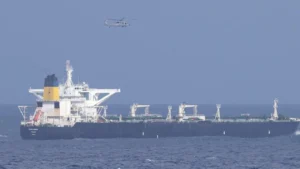
U.S. officials confirmed that the Coast Guard is actively tracking an oil tanker believed to be part of a so-called dark fleet. These vessels are often accused of concealing their true identity, manipulating tracking systems, or sailing under false flags to evade detection. In this case, the tanker is reportedly operating under a judicial seizure order and is suspected of violating international sanctions tied to Venezuela’s oil trade.
The pursuit marks the second such operation within a single weekend and the third in less than two weeks. While officials did not disclose the exact location or formally name the vessel at the time, maritime security sources later identified it as a large crude oil carrier previously placed on a sanctions list due to alleged links with restricted oil exports.
Sanctions and the Dark Fleet Network
Sanctioned oil tankers are often associated with complex global networks designed to move crude oil despite international restrictions. These vessels may disable tracking systems, transfer oil ship-to-ship, or operate through intermediaries to obscure the origin and destination of cargo. U.S. authorities argue that such practices undermine global energy regulations and contribute to illicit financial flows.
In this instance, officials stated that the tanker had not yet been boarded, noting that maritime interceptions can take many forms. These include close monitoring by naval ships or aircraft, as well as direct engagement when legally permitted. The strategy allows enforcement agencies to apply pressure without immediate escalation.
Political Pressure and Strategic Messaging
The intensified maritime actions come amid a broader political campaign aimed at Venezuela’s leadership. Recently, the U.S. administration announced a sweeping measure described as a blockade on sanctioned oil tankers entering or leaving Venezuelan ports. This declaration has been accompanied by an increased military presence in surrounding waters, signaling a willingness to enforce sanctions more aggressively.
U.S. officials maintain that these actions are targeted and limited, focusing specifically on black market operations rather than legitimate global oil supply chains. According to economic advisors, the seizures are unlikely to have a significant impact on domestic fuel prices, as only a small number of vessels are involved.
Impact on Global Oil Markets
Despite assurances, financial markets have reacted cautiously. Oil prices showed a modest increase during early Asian trading sessions, reflecting concerns that tighter enforcement could reduce the availability of certain crude supplies. Traders and analysts often interpret vessel seizures as a potential escalation, particularly when they involve tankers not previously under direct sanctions.
Market observers note that even limited disruptions can influence sentiment, especially when geopolitical risks are already elevated. The perception of uncertainty alone can contribute to short-term price fluctuations.
Consequences for Venezuela’s Oil Industry
Analysts warn that sustained pressure on maritime exports could have serious implications for Venezuela’s oil-dependent economy. Reduced export volumes may quickly lead to storage capacity issues, forcing production cuts. Such outcomes could further strain government revenues and complicate efforts to stabilize the energy sector.
Energy experts suggest that while Venezuela has stated its intention to continue oil trading, increased enforcement actions raise the cost and risk of doing so. Over time, this could reshape regional energy flows and alter relationships with international buyers.
Broader Geopolitical Implications
The ongoing pursuit underscores how maritime enforcement has become a central tool in modern geopolitical strategy. Control over shipping routes and energy transport is increasingly used to apply economic and political pressure without direct confrontation. As global demand for energy remains high, the balance between enforcement, market stability, and diplomatic relations will continue to be closely watched.
In the coming weeks, further interceptions or seizures could redefine expectations for compliance in international waters and set precedents for how sanctions are enforced worldwide.