STRIKE CONTINUES! Boeing’s ‘Latest & Best’ Offer Rejected as Workers Enter Fourth Month of Walkout
Boeing Strike Contract Offer: The latest contract offer from Boeing Defense (BA.N) was rejected by striking employees in the St. Louis region on Sunday, extending the strike into its thirteenth week and delaying the delivery of fighter planes and other projects.
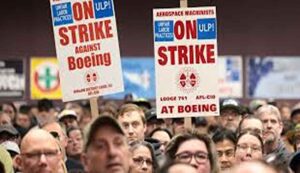
The corporation has not met the demands of the approximately 3,200 members of the International Association of Machinists and Aerospace Workers (IAM) District 837, according to a statement released by union leadership after the decision.
A Corporate Insult’: IAM Leader Slams Rejected Boeing Strike Contract Offer, Says Execs ‘Insulted’ Military Aircraft Builders
In a statement, IAM International President Brian Bryant remarked, “Boeing claimed they listened to their employees – the result of today’s vote proves they have not.” “Boeing’s corporate executives continue to insult the very people who build the world’s most advanced military aircraft – the same planes and military systems that keep our servicemembers and nation safe.”
In a statement, Boeing expressed disappointment at the outcome of the vote, but said that “we are turning our focus to executing the next phase of our contingency plan.”
According to union members, the five-year offer was essentially the same as those that had already been turned down. In exchange for $3,000 in Boeing shares that vest over three years and a $1,000 retention incentive over four, the corporation decreased the ratification bonus. In the fourth year of the contract, it also enhanced compensation increases for the highest-paid employees.
In a note to employees on Thursday, Boeing Vice President Dan Gillian said, “To fund the increases in this offer, we had to make trade-offs,” including lower hourly salary increases linked to attendance and specific shift work.
IAM officials have put pressure on the aircraft manufacturer to increase retirement plan contributions and provide a ratification incentive that is comparable to the $12,000 Boeing provided to union members who went on strike in the Pacific Northwest’s commercial jet division last year.
Gillian of Boeing has referred to the company’s offer as a historic agreement and “market-leading,” and he has said time and time again that Boeing would simply change the value of its conditions rather than raise their total worth.
When Boeing releases its third-quarter earnings on Wednesday, it is anticipated to disclose yet another unprofitable quarter. The business is six years behind schedule and has not yet received regulatory certification for its 777X program, which Wall Street analysts predict will result in a multi-billion-dollar expense.
IAM members gave their approval to the union’s proposed four-year contract in September. The management of Boeing, however, has declined to take that offer into consideration.
In comparison to the company’s offer that was turned down, the IAM calculates that its offer would raise the agreement’s cost by around $50 million over the course of its four-year term. Kelly Ortberg, the CEO of Boeing, is expected to make $22 million this year.
In an unfair labor practice complaint submitted to the National Labor Relations Board on October 16, union representatives accused Boeing of engaging in bad faith negotiations.
“It’s well past time for Boeing to stop cheaping out on the workers who make its success possible and bargain a fair deal that respects their skill and sacrifice,” Bryant said.
According to union members, they are making ends meet by combining second jobs, belt tightening, and $300 a week in strike benefits from the IAM. According to Boeing, striking employees’ access to company-sponsored health insurance expired on August 30.
Boeing executives have said time and time again that the company’s mitigation strategy has lessened the impact of the work stoppage on production since the strike started on August 4.
However, in remarks provided to the Senate Armed Services Committee during a hearing on his nomination as the Air Force chief of staff on October 9, General Kenneth Wilsbach said that it has caused delays in the delivery of F-15EX fighters to the U.S. Air Force.